The Band Calls A Slow Blues. And You Start Playing It Safe.
The Wall You're Hitting Right Now
You've put in the years. You can play the parts. Your time is solid.
But when the gig hits… when a slow blues, a half-time shuffle, a deep 12/8 gets called… something happens.
Your hands tighten.
Your fills shrink.
The groove starts to feel like work.
You record yourself and wince. You watch other drummers and wonder what they're doing that you're not. You leave the gig feeling like you played the notes, but the music never showed up.
You're not bad. You're not behind.
You're hitting the wall every serious drummer hits.
Does this sound like you?
It's Not Your Hands. It's The Missing Vocabulary.
Most drummers think the answer is more chops. Faster hands. Cleaner fills. More hours.
It's not.
What separates a stiff shuffle from one that actually swings lives in the cracks. Phrasing. Nuance. Dynamic balance. The way the note before the backbeat lands. How much you swing the let of the triplet.
These are tiny details. Almost nobody teaches them, because almost nobody actually plays them.
That's why the same drummers who can sight-read anything still sound flat the second a slow groove gets called.
It's not a talent problem.
It's a vocabulary problem.
And once you actually hear it, you can't un-hear it.
30 Years Of Real Gigs. 30 Years Of Watching Drummers Hit This Same Wall.
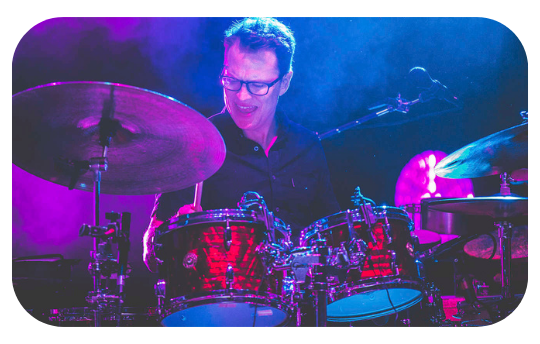
I'm Stanton Moore. I've spent the last three decades playing these grooves for real, on real records, in real rooms.
With Galactic. With Irma Thomas on After The Rain. With Johnny Sansone on the record that won the Memphis Blues Award. Even with Corrosion Of Conformity on In The Arms Of God. Yeah, the metal one.
Different bands, different genres, same lesson, over and over:
The drummers who get called back aren't the ones with the fastest hands. They're the ones who make the groove feel good. Period.
I learned this watching Herlin Riley at Snug Harbor. From years studying with Johnny Vidakovich. From chasing the phrasing of Art Blakey, Earl Palmer, and Bernard Purdie and figuring out what they were actually doing that nobody had ever written down.
I built this course out of all of it.
The stuff that actually survives the gig.
What You Get
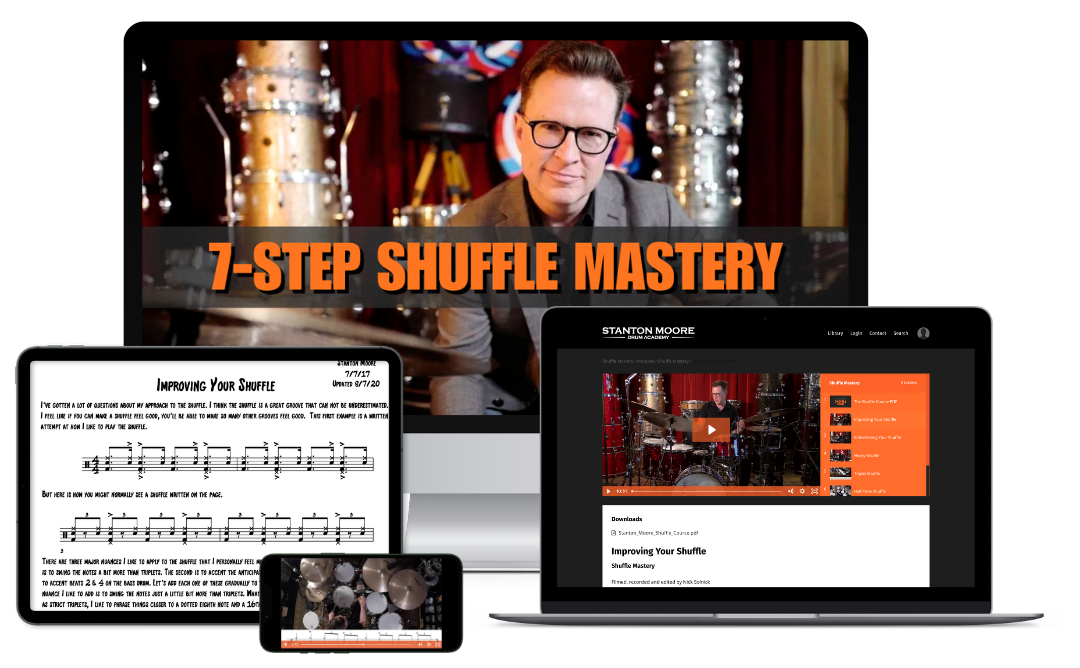
The three tiny nuances that make Herlin Riley's shuffle swing harder than anyone's. Start here.
Buzzes, diddles, hi-hat shoops, middle triplet partials. The variations that kill the "same three fills" problem.
The Bonham / Bill Ward / Ian Paice school. The one I recorded on Corrosion Of Conformity's In The Arms Of God. The bass drum shuffle that makes a heavy band actually heavy.
The groove behind "Blueberry Hill," "Hot Fun In The Summertime," and "Hold The Line." Straight and broken — both versions, both feels.
Purdie's "Home At Last." Bonham's "Fool In The Rain." Porcaro's "Rosanna." The three most-asked-about grooves in drumming, broken all the way down.
The in-between-straight-and-swing feel Earl Palmer hid inside half the records you grew up on. Charles Connor's "choo-choo beat." My go-to in the studio.
The deep pocket most drummers skip. "Stormy Monday." "Gravity." Classic Al Green. With the skip beat that finally makes it breathe.
33 pages of notated examples. Every groove. Every variation. Shed at your own pace.
The Shuffle Is The Vehicle. Feel Is The Destination.
Yes, this teaches 7 shuffles.
What it's actually teaching you is how to stop sounding stiff. How to phrase. How to balance dynamics. How to find the cracks between straight and swing.
Once those concepts are in your hands, they don't stay in the shuffle. They show up in your funk. Your rock. Your jazz. Everything.
Because most musicians aren't looking for the drummer with the most chops.
They're looking for the drummer who makes the music feel alive.
That's the drummer this course turns you into.
$17 Today. Not For Long.
This just launched. The price is intentionally low to get it into drummers' hands. It is not staying at $17.
One private drum lesson costs three times this — and doesn't cover seven shuffle styles, a notated book, and play-alongs to back it.
From Drummers Who've Done The Work
Is This For You?
This is built for one kind of drummer — the one who can already play, but knows their playing still isn't where it should feel.
This is for you if:
This isn't for you if:
One Year From Now
Picture it.
It's a year from today. You're behind the kit.
Same band. Same bar. Same Saturday night gig.
Someone calls a slow blues.
Path A: Your shoulders tighten. The fills shrink again. You go on autopilot. You drive home thinking I should be better than this by now. Another year. Same groove. Same gap.
Path B: You smile. Because you've shed this. You sit deeper. The pocket breathes. The bass player looks over with that yes face. The vocalist relaxes. And someone in the room — someone who's heard a thousand drummers — leans over and says: "I don't know what it is about that guy, but his feel is amazing."
That's the difference.
Not a year of "almost."
A year of finally sounding like the drummer you've heard in your head all along.
Quick Questions. Honest Answers.
Is this really worth $17?
One private drum lesson costs three times this. For $17 you're getting years of gig-tested vocabulary, every essential shuffle, the notated book, and the play-alongs.
I've been playing for decades. Is this too basic?
No. This is built for experienced drummers. The depth is in the phrasing — the stuff most courses skip because most teachers don't actually play it.
I already own drum courses. How is this different?
Most courses give you patterns. This gives you the songs the patterns came from, the drummers who made them famous, and the small nuances that make them feel alive. Patterns don't survive a gig. This material does.
What if it doesn't work for me?
7-day money-back guarantee. Watch everything. If it doesn't change how your shuffle feels, email us. No hoops.
How fast will I see results?
Depends how much you shed. Some nuances click in a day. Others take weeks. The course and book are yours for life — no rush.
Is this for beginners?
No. You should already be able to hold a basic groove at the kit. If you can do that, you're ready.
Still Here? Then You Already Know.
You can already hear the difference between keeping time and
making the music feel good.
You've heard it on records. You've watched other drummers do it. You've felt the gap between what you're playing and what you wish was coming out.
This is the work that closes it.